
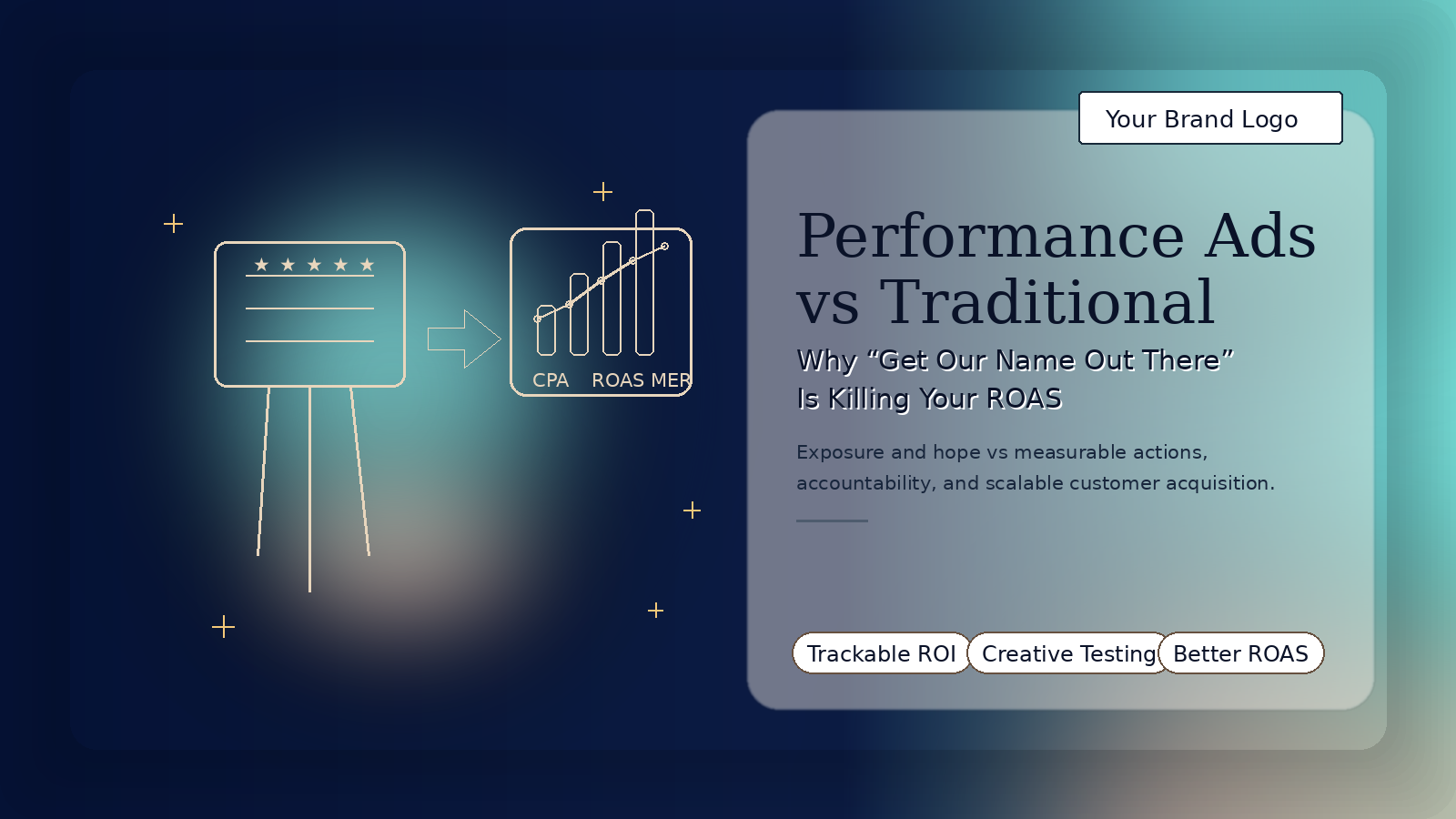
Performance Advertising vs Traditional: Why “Let’s Just Get Our Name Out There” Is Killing Your ROAS
Once upon a time, marketing meetings were simple.
You picked a magazine, a radio station, maybe a billboard on the highway. You handed over a cheque that made your accountant wince, the ad ran, and everyone crossed their fingers.
“Did it work?”
“Well… traffic felt busier. The phone rang a bit more. Hard to say. But at least we got our name out there.”
Fast forward to 2026, and a lot of DTC/ecom founders are still running their ads with that same energy—just with a Meta pixel slapped on top.
“Let’s boost a few posts and see what happens.”
“We’ll just run some awareness campaigns first.”
“We don’t need to track every little thing; it’s about the brand.”
And that is exactly how good products with real potential burn through ad budgets and convince themselves, “Facebook/Google just doesn’t work for us.”
The truth? It’s not that performance advertising doesn’t work.
It’s that many brands are still playing by traditional rules in a performance world.
Let’s change that.
Traditional vs performance: what actually changed?
Traditional advertising is built on exposure and hope.
You pay upfront for the chance that enough of the right people see your message and maybe, eventually, some of them buy. Measurement is fuzzy, timelines are long, and most of the value sits in “intangibles” like awareness and perception.
Performance advertising is built on actions and accountability.
You pay for outcomes: clicks, leads, adds-to-cart, purchases. You can see, almost in real time:
- How many people saw the ad
- How many clicked
- How many bought
- Exactly how much you paid to acquire each customer
Instead of, “We ran a campaign and sales were up a bit,” you can say:
“We spent $10,000, made $42,000 in tracked revenue, and acquired 670 new customers at $14.93 each.”
That shift—from fuzzy to forensic—is the heart of performance.
But for DTC/ecom founders, there’s something even more important:
Performance advertising doesn’t just measure reality. Done properly, it shapes it.
Every ad is a live experiment. Every click is feedback. Every conversion is proof of what stories, offers and creative your market actually responds to.
Traditional throws a message into the world and hopes it resonates.
Performance learns what resonates and doubles down.
Why “let’s just get our name out there” is dangerous now
There’s nothing wrong with wanting awareness or a strong brand.
The problem is using “brand” as a polite way of saying “we’re not actually measuring anything” in a landscape where your competitors absolutely are.
When a founder says, “We just need to get our name out there,” what they often mean is:
- “We don’t have a clear acquisition target.”
- “We’re not sure who our best customers are.”
- “We’re not confident about our offer, so we’re avoiding hard numbers.”
In 2026, that vagueness is expensive.
Because while you’re “getting your name out there”, sharper operators are:
-
- Buying the same media
-
- With tighter targeting
-
- Stronger offers
-
- Better creative
-
- And clear performance targets
They’re not just getting seen. They’re getting paid.
The real differences (in founder language, not buzzwords)
1. How you pay
-
- Traditional: You pay to show up. TV, radio, print, sponsorships, even some “branding” digital campaigns. The bill arrives whether anyone cared or not.
-
- Performance: You pay for outcomes. Clicks, leads, purchases. You’re buying actions, not vibes.
2. How you measure
-
- Traditional: “We ran a campaign and overall sales went up 7%.” Was it the ads? Seasonality? A TikTok that went viral? Nobody really knows.
-
- Performance: “This campaign generated 257 purchases at $38 CPA, with an average order value of $96 and projected LTV of $240.” Now you can make grown-up decisions.
3. How you improve
-
- Traditional: Big bets, slowly. New TVC, big brand film, months of work.
-
- Performance: Lots of small bets, quickly. New hooks, offers, creatives, audiences, landing pages. Test → learn → redeploy.
For an ecom brand, whose entire business lives or dies on acquiring and retaining customers efficiently, this isn’t a subtle difference. It’s the difference between a controllable machine and a very expensive lottery ticket.
“We’re not a spreadsheet brand, we care about story”
Good. So do we.
The best performance advertising isn’t anti-story; it’s a story that has to fight for its life in the real world.
Traditional thinking says:
“If the ad is beautiful and on-brand, it’s done its job.”
Performance thinking says:
“If the ad is beautiful, on-brand, and actually makes strangers buy, it’s done its job.”
The story still matters. The emotion still matters. The visual craft still matters.
The difference is, with performance, you don’t get points for effort. You get points for effectiveness.
If you believe in your product, that should feel like an upgrade, not a threat.
Where “traditional” thinking secretly infects your digital ads
A lot of what passes for “performance” is just traditional advertising with a pixel and a prayer.
Red flags:
- “Let’s run some awareness campaigns for a few months and see what happens.”
- “We just want reach and impressions right now.”
- “We boosted a post and got great engagement.”
Engagement is not a business model. Impressions don’t pay your team.
For DTC/ecom, performance advertising isn’t defined by the channel (Meta, Google, YouTube). It’s defined by the contract:
“We spend money. It produces trackable customer actions. If it doesn’t, we change it.”
That contract is what separates grown-up growth from “we hope Q4 is better this year.”
What proper performance looks like for a DTC/ecom brand
A mature performance setup usually includes:
Clear objectives
Not “get our name out there”.
Things like:
- Acquire new customers at or below $X CPA
- Hit a target MER (marketing efficiency ratio)
- Grow revenue from paid by Y% while protecting margins
Offer-led strategy
The offer is the real hero. Not lazy 10% discounts, but:
- Smart bundles and AOV boosters
- Entry products that lead into higher-LTV journeys
- Seasonally and emotionally relevant angles
Creative built to be tested, not worshipped
Multiple concepts:
- Problem/solution
- Before/after
- Social proof
- Founder story
The point is competition: let the market choose your winners.
Tight tracking and attribution
-
- Proper event setup
-
- Fixed UTM discipline
Founder-friendly dashboards answering:
-
- What did we spend?
-
- What did we make?
-
- What do we change next?
Iterative optimisation
Weekly decisions:
-
- Pause losers
-
- Feed winners
-
- Spin out new versions of what works
-
- Fix funnel bottlenecks (e.g. great CTR but weak conversion → landing page issue)
That’s performance. Not “we run some ads.”
A system that treats media like an investment, not a donation.
So is traditional dead?
No. It’s just no longer the default.
Traditional-style plays can still make sense:
-
- Major rebrands
-
- Big retail expansions
-
- Category education when people don’t even know they have the problem yet
But for DTC/ecom brands, especially online-first, reality is simple:
-
- You need measurable, efficient acquisition first.
-
- Then you can layer in bigger “brand” moments, knowing the machine is funded.
Traditional says: “Let’s spend big, then see what happens.”
Performance says: “Let’s make sure every dollar has a job. Then we can decide how dramatic we want to be.”
The mindset shift that changes everything
If you take nothing else, take this:
Stop thinking like a brand that occasionally buys ads.
Start thinking like an investor in customer acquisition.
Investors ask:
-
- What’s my expected return?
-
- How quickly do I get my money back?
-
- What are the risks?
-
- How do we de-risk and scale?
Performance advertising gives you those answers.
Traditional advertising gives you a nice warm feeling and a pretty PDF.
Both have a place. Only one pays your media bill with actual numbers.
Where emmersion fits
Most agencies will happily sell you “performance” and then build you a glorified awareness campaign with nice graphics.
Immersion exists for founders and marketing leaders who want the opposite:
-
- Brand with a backbone. Creative that looks good, feels right, and still has to earn its keep.
-
- Performance with a soul. Not just spreadsheets and hacks, but story-led campaigns that build equity and hit targets.
-
- Straight talk. If we wouldn’t spend our own money on it, we don’t spend yours.
If you’re tired of guessing and “hoping” the ads are working, performance is how you take back control.
And if you already believe in performance but your results feel like a rollercoaster, it’s usually not the algorithm. It’s the strategy, creative, and tracking on top of it.
That’s where we live.
If this hit a nerve, don’t overhaul everything tomorrow.
Start with one live campaign and ask:
-
- What are we actually optimising for?
-
- What’s our real CPA or MER?
-
- What would we change this week if we treated this like an investment, not a gamble?
If you want a second brain on that, this is the sort of thing Immersion does before breakfast. No pressure, no pitch deck—just clear eyes on what’s working and what’s quietly draining your ad account.
